
Why your minimum payment today reduces less of your debt
Learn why making only the minimum payment barely shrinks your credit card debt, how interest charges impact your balance, and practical steps you can take to clear it more quickly.
Caution: Your Minimum Payment Could Be Keeping You Stuck in Debt
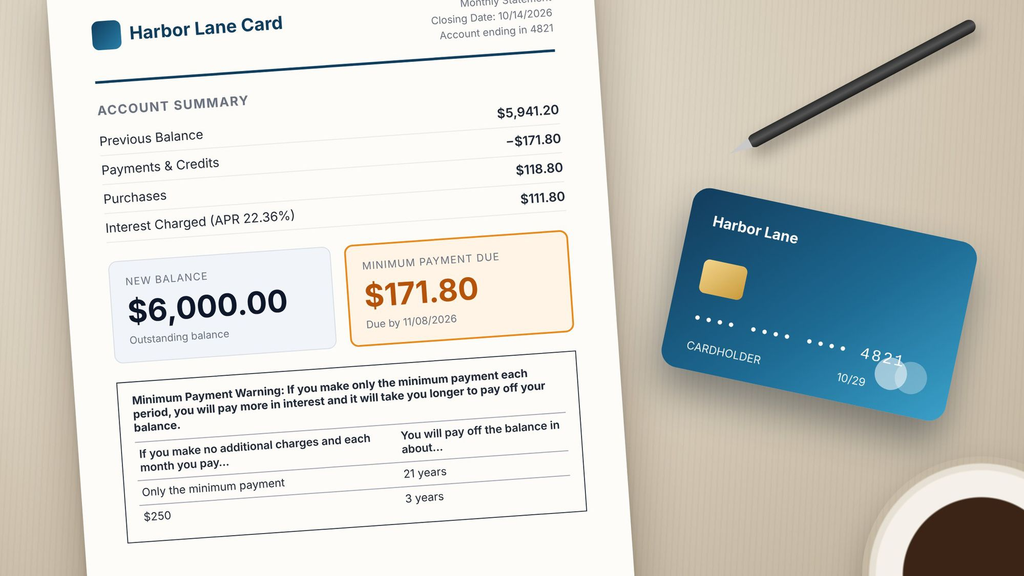
You consistently pay your credit card bill each month, so why does your balance hardly budge?
The culprit might be your minimum payment. When interest rates are steep, a large portion of your payment goes to interest rather than lowering what you owe.
On top of that, new charges and fees can make the situation even more challenging.
As of August 2026, the Federal Reserve reported that the average annual interest rate on U.S. credit card accounts carrying interest was 22.36%.
At the same time, Americans carried roughly $1.263 trillion in credit card debt during the second quarter of 2026.
Knowing how your minimum payment is calculated can help you lower interest charges and steadily work toward paying off your debt.
Why Your Minimum Payment Reduces Less Debt Than You Think
Your minimum payment is the least amount your credit card company requires by the due date to keep your account in good standing.
However, paying just the minimum doesn’t necessarily mean you’re making meaningful headway in reducing your overall debt.
The Consumer Financial Protection Bureau (CFPB) cautions that making only the minimum payment typically results in paying more interest and extending the time it takes to clear your debt.
There are three main reasons why paying off your debt can become more difficult.
1. High Interest Rates Reduce Your Payment’s Impact
Carrying a balance on your credit card means interest charges increase the total amount you owe.
The greater your APR (annual percentage rate), the higher the interest costs you’ll accumulate.
Here’s an example to consider:
- Credit card balance: $5,000
- APR: 22.36%
- Estimated monthly interest: $93.17
- Example minimum payment: $100
- Amount going toward principal: only $6.83
This example simplifies things and doesn’t reflect every minimum payment calculation. Actual interest depends on factors like your daily balance, billing cycle, and the terms set by your credit card issuer.
The main point remains: high interest rates often leave only a small portion of your payment to reduce your actual debt.
2. Your Minimum Payment Amount May Vary
Credit card companies use various methods to figure out your minimum payment.
Your minimum payment might be calculated based on a percentage of your balance, a set dollar amount, accrued interest and fees, or a mix of these depending on your card’s terms.
As you reduce your balance, your minimum payment is likely to drop as well.
This can make your monthly bill more affordable, but if you only pay the lowered minimum, it could slow down how quickly you pay off your debt.
Tip: When possible, try to pay more than the required minimum even if your minimum payment drops.
3. New Purchases Can Undo the Progress You’ve Made
Paying down your balance doesn’t always mean it will drop quickly.
Picture this:
- Make a $200 payment on your card.
- Charge $150 in new spending.
- Accumulate $40 in interest and fees.
After those transactions, your balance only drops by $10, assuming no other changes.
That’s why it’s important to monitor more than just your monthly payment. Keep an eye on your balance, interest fees, charges, and any new transactions together.
What Happens When You Pay Only the Minimum?
Making only the minimum payment can keep your account in good standing. But consistently doing so can increase the total cost of your debt.
Here are three effects this can have.
You End Up Paying More Interest
The longer you carry a balance, the more interest charges you are likely to incur.
Based on your APR and how you pay, interest can quickly become a large portion of what you owe overall.
Your Debt Will Take More Time to Settle
If most of your payment goes to interest, your principal balance reduces very slowly.
Continuing to make new charges can make it even more difficult to clear your debt.
Less Money Available for Your Other Financial Priorities
Interest payments reduce funds you could use for important expenses like:
- Housing and food costs
- Emergency fund savings
- Contributions to retirement
- Other bills you owe
When funds are limited, making just the minimum payment might be your only viable choice. The key is to recognize the costs involved and aim for a repayment strategy you can maintain over time.
Ways to Make Your Minimum Payment Reduce More of Your Debt
You don’t have to completely change your financial habits all at once.
Begin by taking a few simple, manageable actions.
Try to Pay More Than the Minimum When You Can
For example, if your minimum is $100 but you’re able to pay $150 comfortably, that extra $50 goes straight toward lowering your principal faster.
Reducing your principal balance can also help cut down on interest charges over time.
Still, avoid pushing your budget so far that you must borrow more to cover basic needs.
Select a payment amount you can consistently manage each month.
Examine Your APR and Credit Card Statement
Reviewing your monthly statement can reveal why your balance isn’t dropping.
Look for these key details:
- Your current APR
- The interest charged
- Your minimum payment
- Your payment due date
- Your outstanding balance
Now consider this:
Is my balance really going down?
Look at your balance month over month. If it barely shifts, check your interest fees and any recent charges.
Request a Lower APR from Your Card Issuer
If high interest is making it hard to pay off your balance, reach out to your credit card provider.
Check if you qualify for any of the following options:
- Reduced interest rate
- Hardship assistance program
- Alternative payment plans
While approval isn’t assured, simply asking can help you find options that better fit your situation.
You might also want to explore balance transfer cards or debt consolidation loans as alternatives.
Before agreeing to any offer, be sure to review transfer fees, when promotional rates expire, and the standard APR that applies afterward.
A lower advertised interest rate doesn’t necessarily mean the overall cost is less.
Review Your Repayment Estimate
Credit card statements that apply often include details about how long and how much it costs to pay just the minimum.
Your monthly statement might also provide an estimated payment amount needed to clear your balance within 36 months.
Check that estimate carefully and see how it fits within your budget.
If the recommended payment feels too steep, pick an amount you can manage and adjust your strategy as your financial situation evolves.
Why October Is an Ideal Month to Reassess Your Credit Card Debt
October marks National Financial Planning Month across the United States.
This month serves as a perfect prompt to evaluate your spending habits, outstanding debts, and financial objectives before year’s end.
On October 15, 2026, the American Bankers Association Foundation observed its annual Get Smart About Credit Day, focusing on raising awareness about responsible credit use.
With the holidays and travel season nearing, planning ahead can help you steer clear of unnecessary credit card debt.
Take advantage of October by following these five steps:
- List your balances and APRs. Identify your most expensive debts;
- Review your interest charges. See how much of each payment reduces your principal;
- Set a realistic payment target. Protect your budget for essential expenses;
- Plan holiday spending. Decide what you can afford before shopping;
- Track your progress. Compare your balance every month.
You don’t need to clear your debt by year-end. The key is to wrap up the year with a better strategy in place.
When to Get Help With Credit Card Debt
If your balance continues to rise or you can’t keep up with your minimum payments, it’s important not to ignore the issue.
The Consumer Financial Protection Bureau advises reaching out to your credit card issuer quickly if paying your bill becomes difficult.
Inquire about hardship programs, lower interest rates, or alternative repayment options.
Another option is to seek assistance from a trusted nonprofit credit counseling organization.
Watch out for companies that:
- Promise to erase your debt completely.
- Require large fees upfront.
- Advise you to stop talking to your credit card issuer.
These are common indicators of potentially unsafe debt relief offers.
If covering your basic expenses is a challenge, focus on essentials first and consult trustworthy experts before agreeing to any repayment strategy.
Author’s Perspective
Dealing with credit card debt can be frustrating because it feels like you’re doing everything right.
You make your payments every month, yet your balance hardly decreases.
The issue is that your minimum payment is set to meet the required payment, not to help you eliminate debt quickly.
When interest rates are high, even a small increase above the minimum payment can make a big difference.
However, this doesn’t mean you should cut back on necessary expenses just to pay off your debt faster.
Begin by checking your APR, getting familiar with your statement, and choosing one practical change to make.
You could pay a bit more, avoid adding new charges to a balance-carrying card, or ask your issuer if a lower rate is available.
You don’t have to clear your debt instantly. It’s important to grasp why your minimum payment reduces your balance so little and develop a doable plan to improve that.
Recommended Content
2027 social security raise
Learn when payments change, how much you may receive, and how Medicare costs affect your budget.
Continue Reading * You will remain on the current website